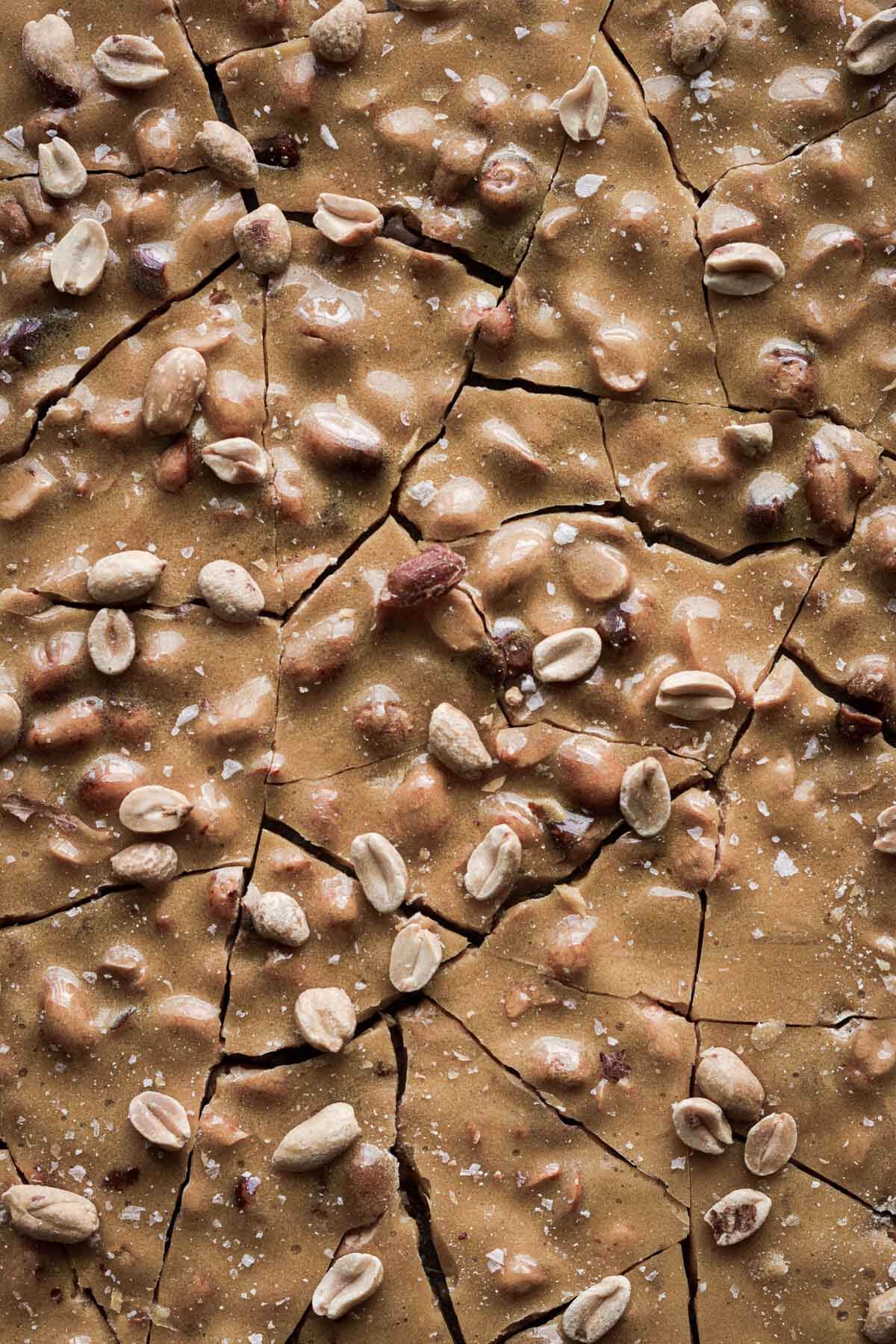
A high altitude tested recipe for the best homemade peanut brittle. This classic candy is sweet and salty, nutty with notes of vanilla, and perfectly crunchy. Use any nuts you like in this recipe! (Video Coming Soon…)
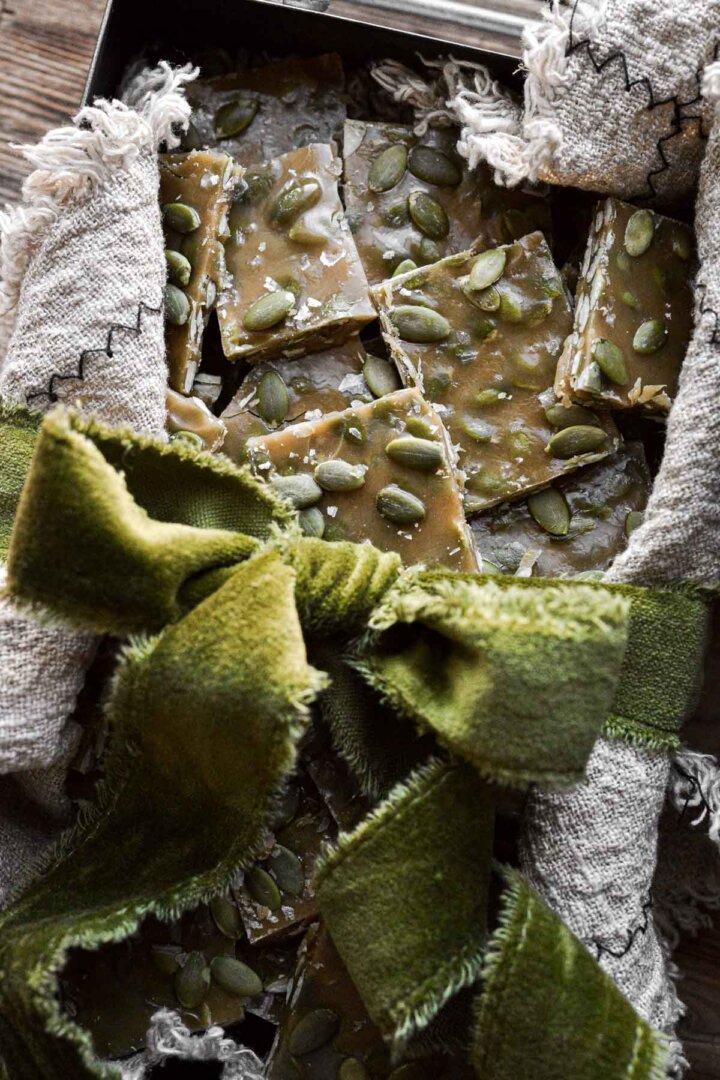
You might also love these recipes for soft and chewy salted caramels, toasted pumpkin seed toffee, and classic English toffee.
This site contains affiliate links. As an Amazon associate, I earn from qualifying purchases. This means that I may make a small commission if you purchase a product using those links. This in no way affects my opinion of those products and services. All opinions expressed on this site are my own.
Why You’ll Love This Recipe
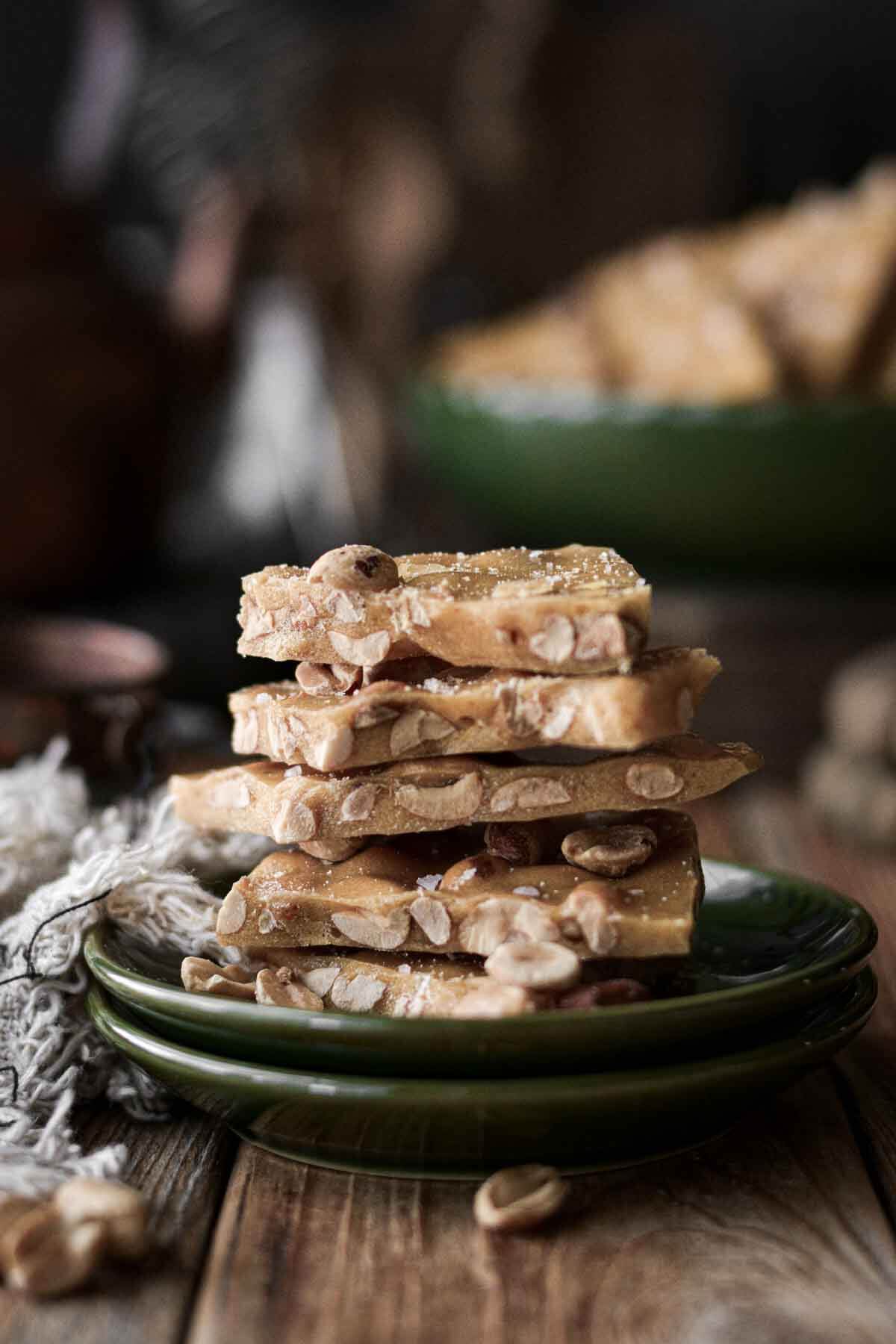
Perfect for the Holidays. Homemade peanut brittle is such a delicious treat that looks absolutely beautiful stacked on a pretty pedestal dish for a holiday gathering or tied up with a ribbon in a cute little gift bag. It’s perfect for packaging in pretty boxes for homemade gifts, or to include in your Christmas cookie box.
Uses Standard Pantry Ingredients. There’s no complicated or hard-to-find ingredients, just simple, standard items that most cooks and bakers will have on hand.
High Altitude Tested. I develop all the recipes on my site for Denver’s altitude of 5,280 feet. If you’re at a lower or higher elevation, please see my FAQs for guidance on adjusting recipes for your altitude.
What’s the Difference Between Brittle and Toffee?
While both brittle and toffee are hard, crunchy candies made from cooking sugar to the “hard crack” stage of candy making, there are a few key differences.
- Toffee includes far more butter, which gives it a richer, fuller, creamier flavor and texture. Nuts are optional in toffee, although I love adding almonds to my classic English toffee (almond roca). After the toffee hardens, it’s also often covered in chocolate with nuts sprinkled over the chocolate, then broken into pieces after the chocolate hardens.
- Brittle contains little to no butter (today’s recipe only uses 2 tbsp), so the flavor can be a bit sweeter since sugar is the primary base of the candy, although salt and vanilla help to balance the sweetness. Nuts or seeds, usually peanuts or cashews, are a defining feature in brittle. And the addition of baking soda adds tiny carbon dioxide bubbles which aerate the candy, giving the brittle the ultimate light and shatteringly crunchy texture.
Which is Easier to Make, Brittle or Toffee?
Both brittle and toffee use a very similar cooking method with a similar list of ingredients (although, with notably less butter in toffee). Sugar, corn syrup, and water, as well as vanilla extract, salt and butter, are cooked on the stove to the hard crack stage (which you need to carefully monitor with a candy thermometer – more on that in the next sections). When it’s ready, the boiling hot sugar mixture is then poured onto a baking sheet, where it will quickly harden as it cools. When completely cool, you can cut or break it into pieces.
Having made both, my opinion is that brittle is easier, simply because it’s a bit less finicky, and less prone to crystallizing. This is likely due to the much higher ratio of corn syrup used in the recipe. As an invert sugar, the corn syrup stabilizes the sugars, preventing a grainy or crystallized texture. But, both are so incredibly fun to make (and even more fun to eat), and if you follow the recipe, you’re sure to be successful.

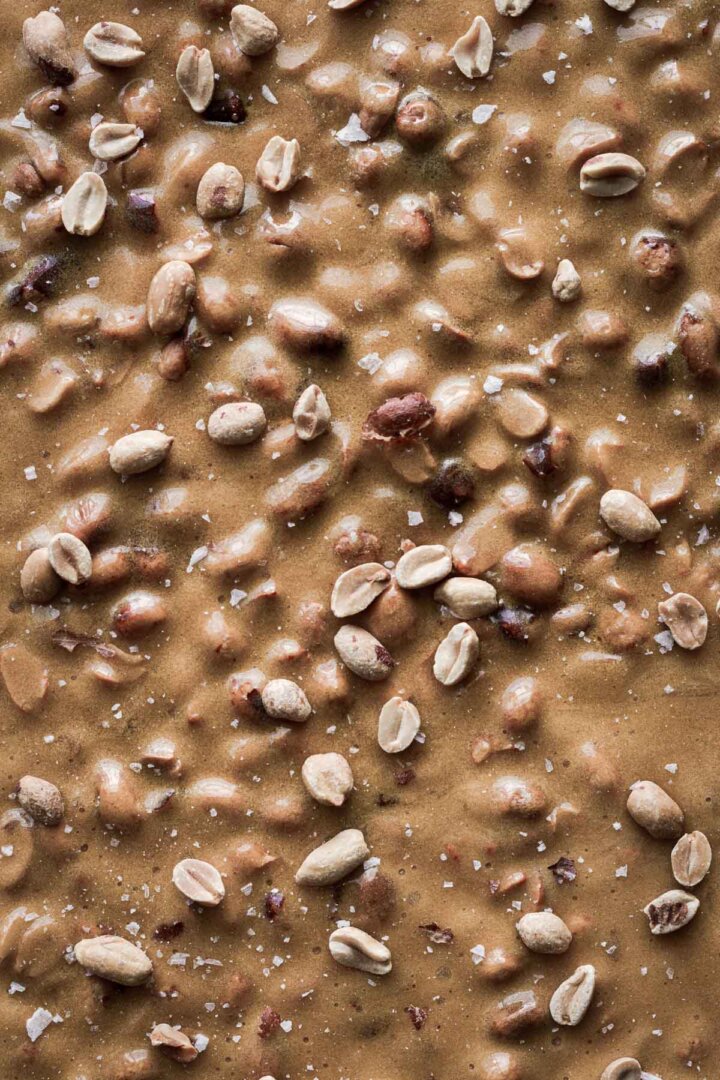
The Stages of Candy Making
Stages of candy making are based on the temperature of the boiling sugar (as well as the texture and appearance of the sugar when it’s dropped into cold water). These are the standard temperature ranges for sea level. We’ll discuss adjusting these for high altitude in the next section.
- Thread (223 – 235 F). At this stage, the syrup drips from a spoon, forming thin threads in water. This is ideal for a glacé or candied fruit that’s glazed in syrup.
- Soft Ball (234 – 245 F). The syrup easily forms a ball in cold water, but flattens once removed from the water. For fudge and fondant.
- Firm Ball (245 – 250 F). The syrup can be formed into a stable ball, but can be pressed flat. For soft caramels.
- Hard Ball (250 – 266 F). The syrup holds its shape but has a sticky texture. For marshmallows and divinity.
- Soft Crack (270 – 290 F). The syrup will form firm but pliable threads. For nougat and salt-water taffy.
- Hard Crack (300-310 F). The syrup will crack if you try to mold it. For brittles, toffee and lollipops.
- Caramel (320 – 350 F). The syrup will turn golden and is very brittle. For pralines or hard caramelized sugar.
Candy Making at High Altitude
Boiling Point of Water and Sugar
Water boils at a lower temperature at high altitude, and the same goes for boiling sugar, too. This means that when making today’s peanut brittle as well as many other types of candy at high altitude, your boiling sugar will reach the candy making stages at a lower temperature than if you were at sea level. It’s important to understand this, because if your brittle doesn’t cook long enough (temperature too low), it will be too soft and chewy. If it cooks for too long (temperature too high), your brittle will end up burned and inedible.
Determining the Boiling Point for YOUR Altitude
So how do you know what temperature your sugar needs to reach when you’re cooking and baking at high altitude? It’s really quite simple. A general rule of thumb is that for every 1,000 feet of elevation, you should subtract 2 degrees. This would mean that someone living at 5,000 feet elevation should subtract 10 degrees. So for the hard crack stage, instead of letting your sugar boil to the range of 300-310F, you should only let it boil to the range of 290-300F.
Boiling Point Test
There’s a more accurate way to determine this for your specific altitude, though. Boil a pot of water with your candy thermometer in the water. When it reaches a full rolling boil, check the temperature. My altitude is just under 5,500 feet, and when I did this test, my water boiled at 201 F, a full 11 degrees lower than the standard boiling point for sea level (212 F). So when I’m making toffee or brittle, if the standard hard crack stage is 300-310F at sea level, then I’m going to aim for a range of 289-299F (11 degrees lower) at my altitude. Make sense?
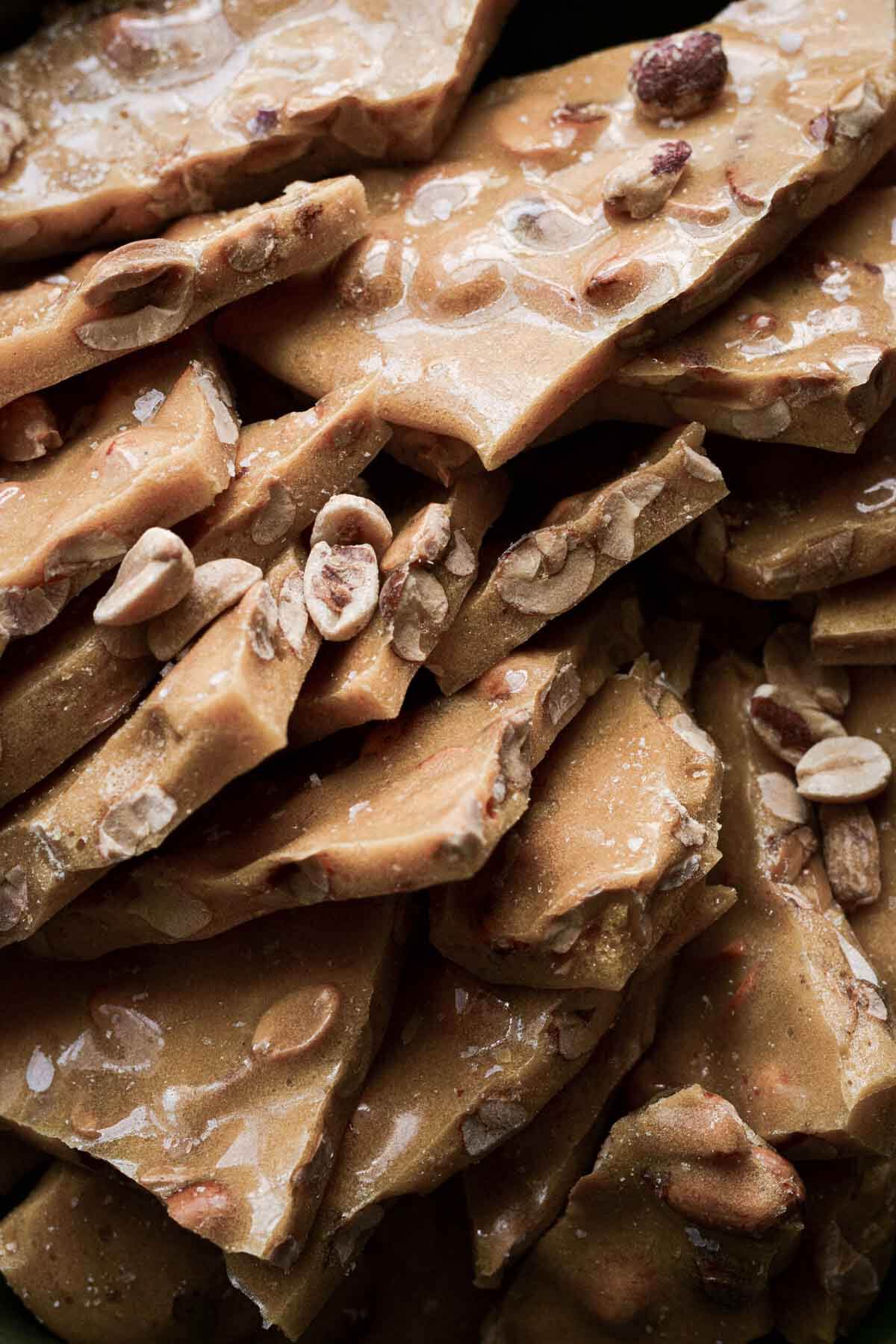
Tools and Equipment
- Large Stock Pot. Use a large, heavy bottomed stock pot so that the sugar cooks evenly.
- Digital Candy Thermometer. This is the digital candy thermometer I use. A thermometer is essential for monitoring the temperature of the boiling sugar.
- Large Baking Sheet + Parchment Paper. After cooking the toffee, you’ll be pouring it onto a parchment lined baking sheet to cool and harden. The brittle doesn’t stick to the parchment paper, making cleanup a breeze.
See the recipe card at the end of the post for the full ingredients list and instructions.
Ingredients
- Sugar. Use plain white granulated sugar, not brown sugar.
- Light Corn Syrup. As an invert sugar, the corn syrup helps to stabilize the sugars in the syrup and prevent crystallization.
- Water.
- Vanilla Extract.
- Salt. I use coarse Kosher salt in my baking, which I cooked directly into the sugar mixture. I also sprinkled the finished brittle with a little flaky Maldon sea salt.
- Butter.
- Baking Soda. When stirred into the hot candy, the baking soda releases millions of tiny carbon dioxide bubbles. These bubbles remain trapped in the candy as it cools, giving the brittle its signature crisp but light texture.
- Peanuts. I used lightly salted, dry roasted peanuts.
Instructions
- Get ready by lining a rimmed baking sheet with parchment paper, and measuring all the ingredients. When the brittle reaches the “hard crack” stage of candy making, you will need to work quickly, so it’s essential to have everything measured and ready to go.
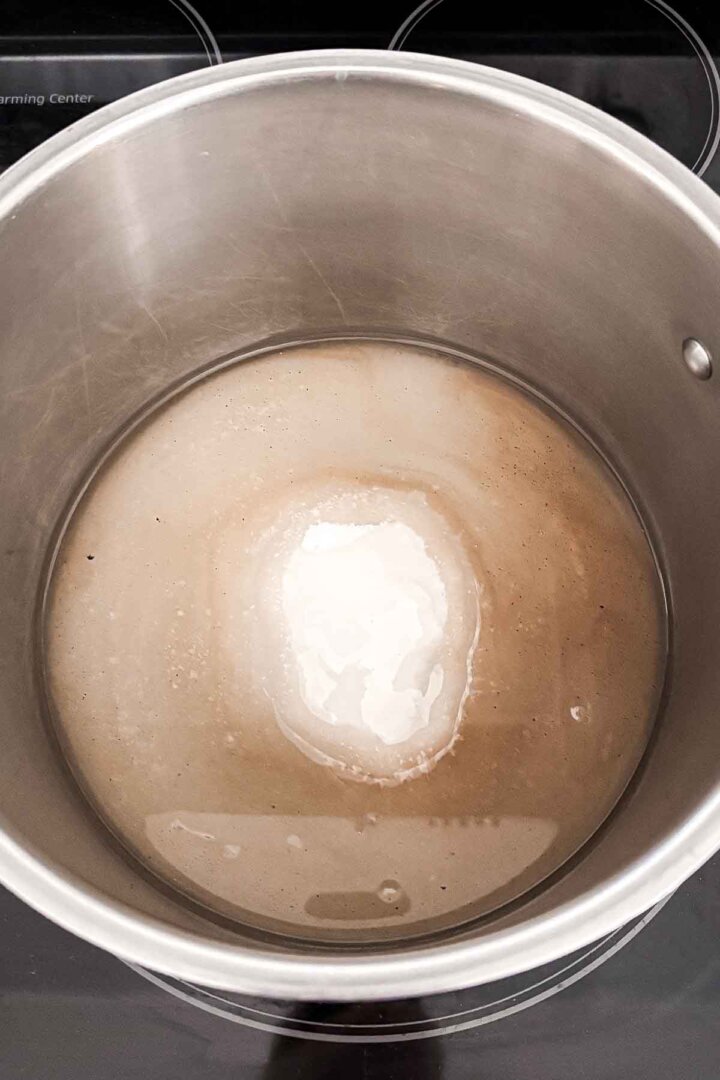
- In a heavy-bottomed stock pot, combine the sugar, corn syrup, water, vanilla, and salt. Clip a candy thermometer (preferably digital) to the side of the pot, so that the tip of the thermometer is submerged in the syrupy liquid.
- Set the pot on the stove, and turn the burner to medium heat or just below medium. You don’t want to cook the sugar too quickly or aggressively, or you’ll risk burning it.
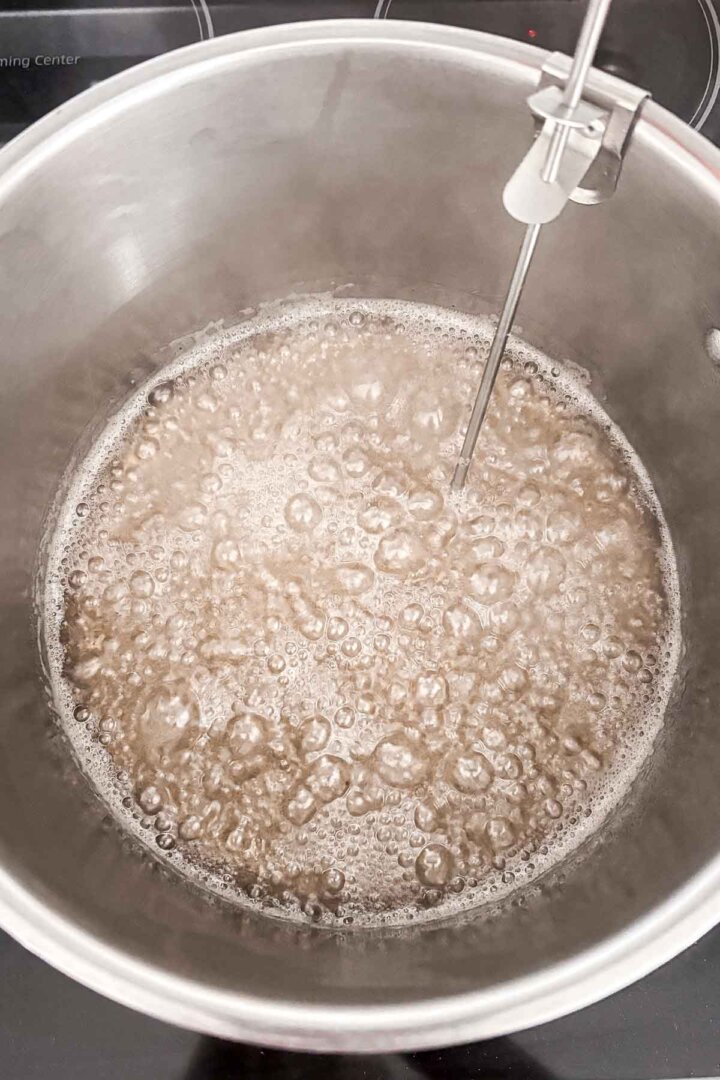
- Cook the sugar, stirring occasionally with a wooden spoon, until the temperature reaches between 240-245 F.
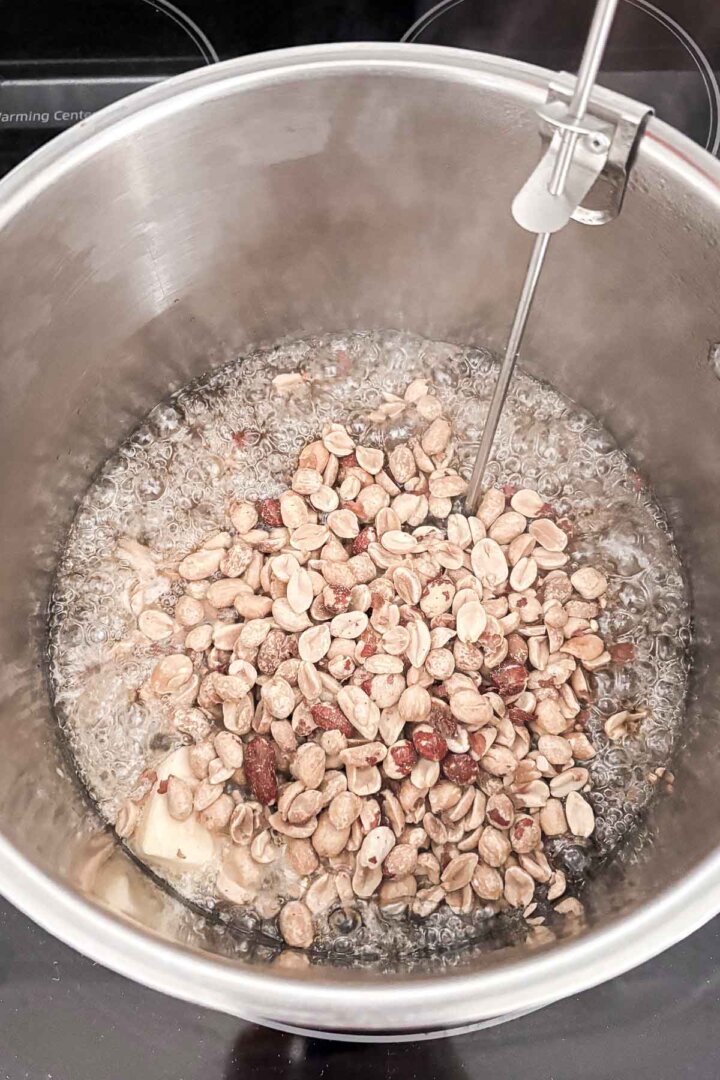
- Stir in the softened butter and the peanuts; you can expect the temperature to drop slightly from the addition of ingredients.
- Continue to cook the candy, stirring occasionally, until the temperature reaches between 290-300 F (hard crack stage for 5,000 feet elevation).
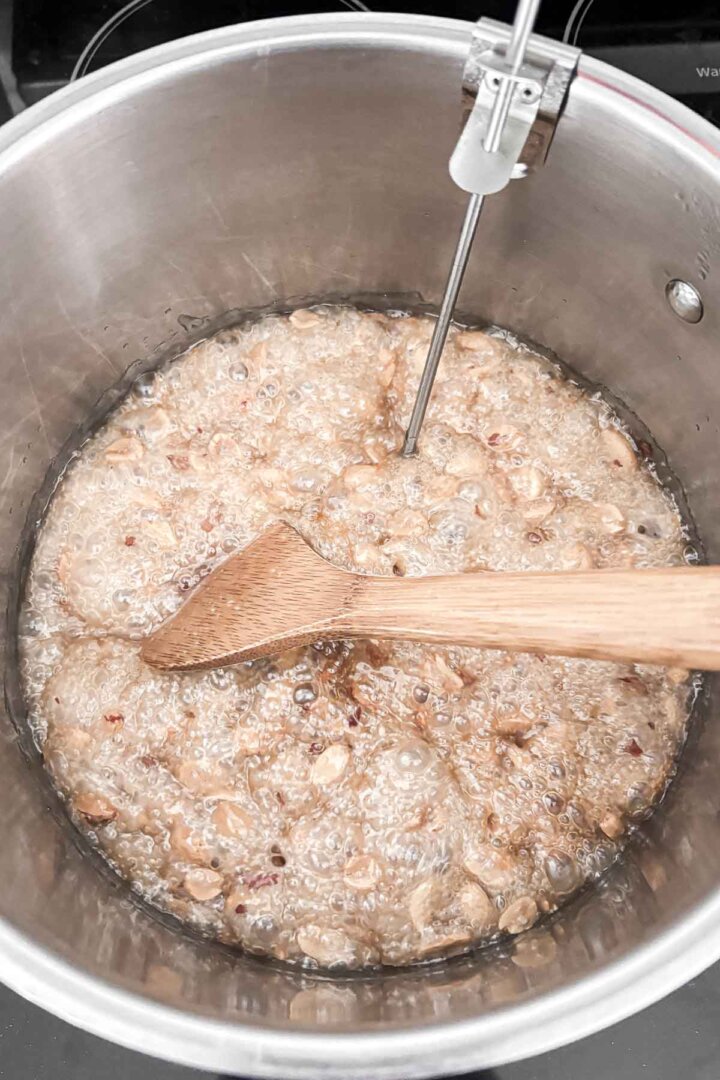
- Remove from the heat and stir in the baking soda, which will make the candy bubble up a bit.
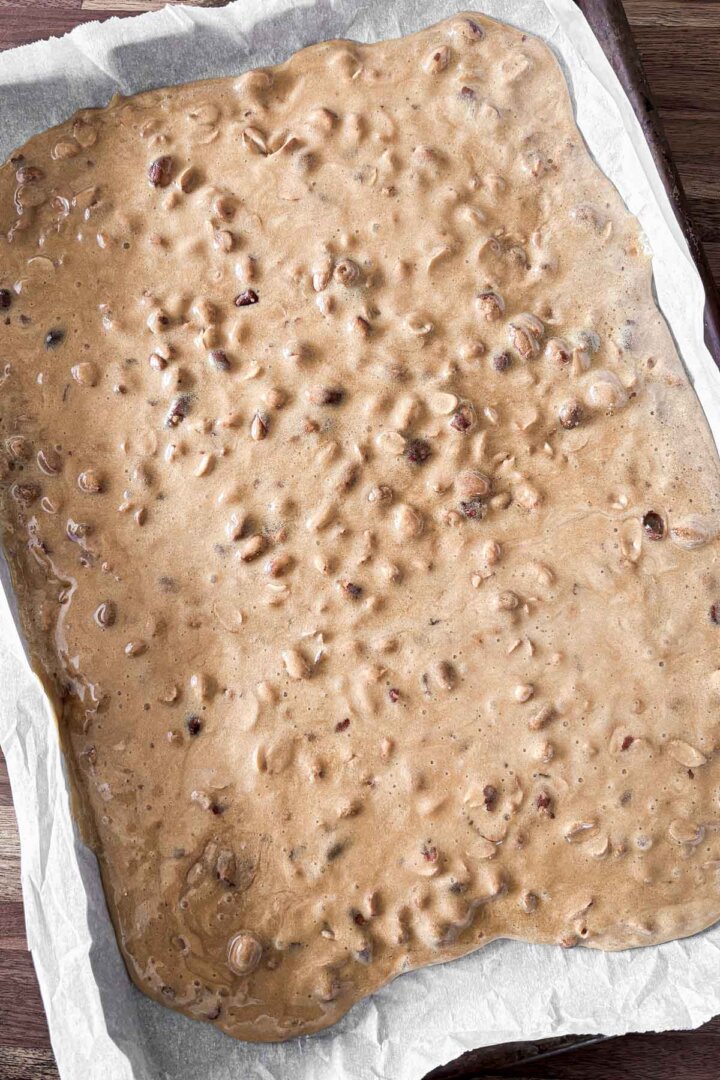
- Working quickly, immediately pour the hot candy onto the parchment lined baking sheet, using the wooden spoon to scrape as much of the candy out of the pot as you can. Spread the candy out with the spoon so it reaches the edges of the pan.
- If you like, immediately sprinkle the top of the brittle with a few extra peanuts and a pinch of flaky salt.
- Let the candy cool completely at room temperature for about two hours.
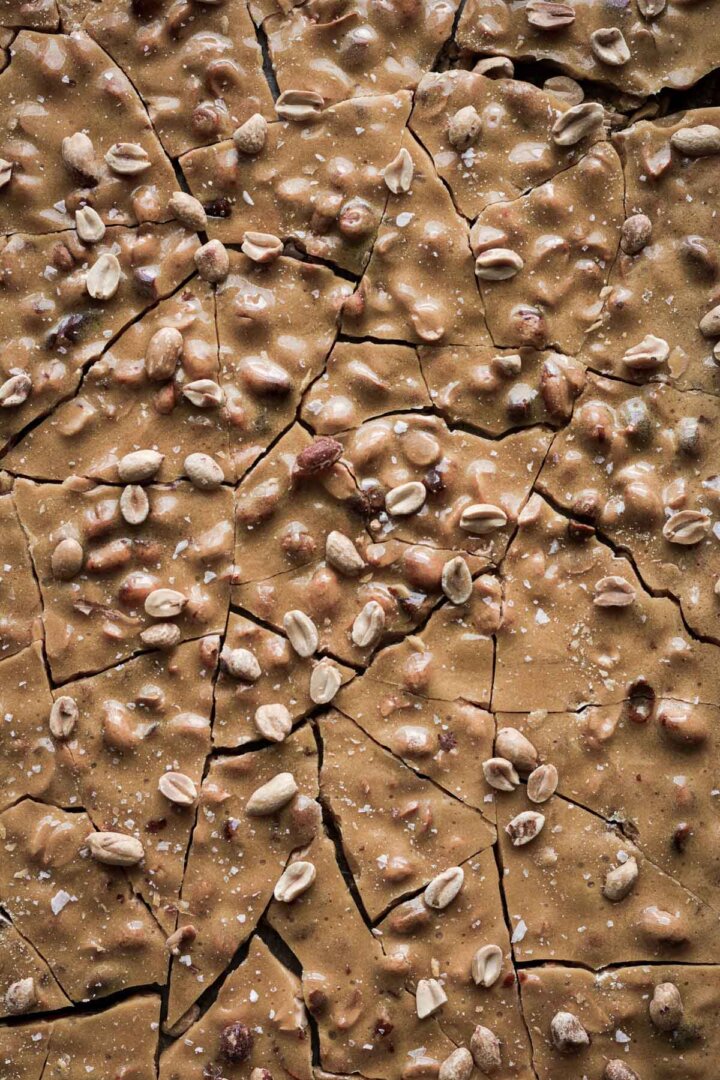
- Use the pointed end of a sharp knife to pierce the hard candy, causing it to break into jagged chunks.
Recipe Variations
- Cashew Brittle. Replace the peanuts with cashews for a delicious treat.
- Seed Brittle. This brittle recipe would be lovely with pumpkin seeds, or even sesame seeds.
- Holiday Nut Brittle. Replace the peanuts with any combination of walnuts, pecans, macadamia nuts, and hazelnuts.
Be sure to read all of my BAKING FAQs where I discuss ingredients, substitutions and common baking questions, so that you can be successful in your own baking!
Frequently Asked Questions
Store leftover candy in an airtight container at room temperature for up to 2 weeks, or in the freezer for up to 3-6 months.
No. The corn syrup, an invert sugar, is necessary to prevent grainyness and crystallization. Although I haven’t tested this substitution, Lyle’s Golden Syrup would likely work just as well, and would add a lovely flavor.
While both are hard, caramelized candies, brittle is mostly sugar, while toffee contains quite a bit more butter for a richer, creamier taste.
You Might Also Like


Please check out my Amazon Shop for a curated collection of some of my favorite cake pans from trusted brands, baking tools, ingredients, pretty things and fashion finds. I recommend products that I buy and use every day!
Did you love today’s recipe? Please rate the recipe and let me know in the comments what you thought! Also, be sure to follow Curly Girl Kitchen on Instagram, and tag me when you try one of my recipes so I can see all your delicious creations!
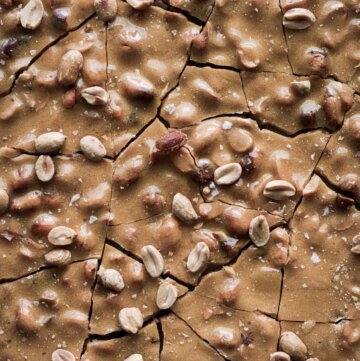
High Altitude Peanut Brittle
All recipes on Curly Girl Kitchen are developed for high altitude at 5,280 feet. See FAQs for adjusting to higher or lower elevations.
Equipment
- Heavy Bottomed Stock Pot
Ingredients
- 2 cups granulated sugar
- 1 cup light corn syrup
- ½ cup water
- 1 tbsp vanilla extract
- ½ tsp coarse Kosher salt (if using table salt, use half the amount)
- 2 tbsp unsalted butter, softened to room temperature
- 2 cups dry roasted, lightly salted peanuts
- 1 ½ tsp baking soda
- peanuts and flaky finishing salt, optional, for sprinkling on top
Instructions
- Get ready by lining a rimmed baking sheet with parchment paper, and measuring all the ingredients. When the brittle reaches the "hard crack" stage of candy making, you will need to work quickly, so it's essential to have everything measured and ready to go.
- In a heavy-bottomed stock pot, combine the sugar, corn syrup, water, vanilla, and salt. Clip a candy thermometer (preferably digital) to the side of the pot, so that the tip of the thermometer is submerged in the syrupy liquid.
- Set the pot on the stove, and turn the burner to medium heat or just below medium. You don't want to cook the sugar too quickly or aggressively, or you'll risk burning it.
- Cook the sugar, stirring occasionally with a wooden spoon, until the temperature reaches between 240-245 F.
- Stir in the softened butter and the peanuts; you can expect the temperature to drop slightly from the addition of ingredients.
- Continue to cook the candy, stirring occasionally, until the temperature reaches between 290-300 F (hard crack stage for 5,000 feet elevation). It may take up to 30 minutes to reach this point from the start, but don't be tempted to walk away. You need to stay near the stove, because although the temperature may start off rising slowly, it can rise very quickly towards the end of the cooking process.
- Remove from the heat and stir in the baking soda, which will make the candy bubble up a bit.
- Working quickly, immediately pour the hot candy onto the parchment lined baking sheet, using the wooden spoon to scrape as much of the candy out of the pot as you can. Spread the candy out with the spoon so it reaches the edges of the pan.
- If you like, immediately sprinkle the top of the brittle with a few extra peanuts and a pinch of flaky salt.
- Let the candy cool completely at room temperature for about two hours.
- Use the pointed end of a sharp knife to pierce the hard candy, causing it to break into jagged chunks.
Notes
 https://curlygirlkitchen.com/

Leave a Reply